Posts transferred from the study program’s former website.
Public Defensio 2026:
Katarina Šoškić
Public Defense 2026
5 May, 13:00–14:30
Works on display:
2–5 May, 12:00–16:00
Location:
Rustenschacherallee 2–4 1020 Vienna
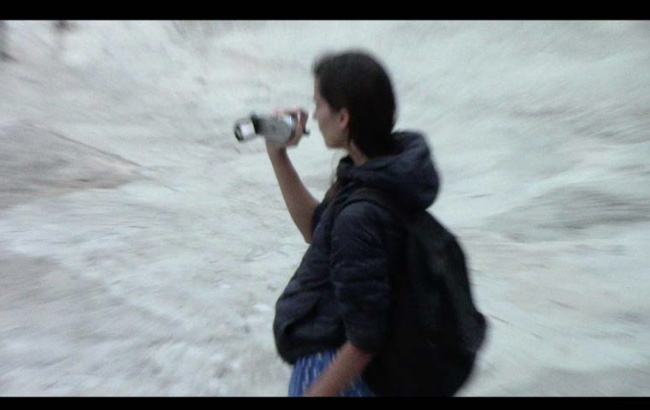
A Circle Around a Photograph: On Photographing as Research
We are delighted to announce the Public Defense of Katarina Šoškić!
This dissertation examines photographing as a research practice, analysing the gestures and processes that precede, surround, and condition the creation of an image.
A photographer often acts from a place of knowing, while a researcher is driven by what is not yet known. As a professional photographer and a researcher, the author asks whether these two seemingly opposed positions can be reconciled, and how photography can function as a mode of inquiry.
Taking the phenomenon of travel and tourism as an initial site for this study, the author tests the capacities of the photographic medium and the roles a photographer and their choices play in documenting, depicting, and generating realities. The author experiments with non-linear forms of text construction, treats the camcorder as a writing tool, and creates chapters of an imaginary audio-photo book. Rather than focusing on the documentary potential of the photographic image and its conventional modes of display, this PhD study employs walking, circling, shifting points of view, filming, and reading in public as means of reporting on the experience of photographing as a bodily, durational, and reflective act.
Public Colloquium 2026
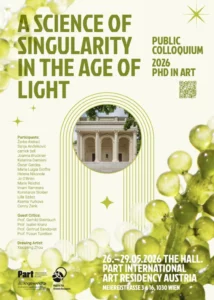
THE HALL, PART International Art Residency Austria
Public Kolloquium 2026
26 – 29 Mai 2026
THE HALL, PART International Art Residency Austria, Meiereistrasse 3 & 16, 1020 Wien
Anreise
PART und die Bildhauergebäude des Bundes befinden sich in der Meiereistraße 3 & 16, 1020 Wien.
Mit öffentlichen Verkehrsmitteln:
- U-Bahn: U2, Station Stadion (Ausgang Ernst-Happel-Stadion), anschließend ca. 300–400 Meter Fußweg.
- Straßenbahn: Linie 18
- Bus: Linien 11A oder 77A
Wir empfehlen Ihnen, mit öffentlichen Verkehrsmitteln, dem Fahrrad oder zu Fuß anzureisen.
A Science of Singularity in the Age of Light
Wir freuen uns, eine neue Zusammenarbeit zwischen dem Künstlerische Forschung PhD in Art an der Universität für angewandte Kunst Wien und PART International Art Residency Austria.
Vom 26. bis 29. Mai findet im THE HALL das Public Kolloquium 2026 als viertägiges offenes Seminar statt. Es bringt Kunstforscher und Publikum in einem gemeinsamen Raum für Austausch und Forschung zusammen.
Das Programm findet dienstags von 13.00 bis 18.00 Uhr und an allen anderen Tagen von 14.00 bis 18.00 Uhr statt.
Im Rahmen des Kolloquiums präsentieren 15 Doktoranden*innen des PhD-Programms Kunst ihre laufenden künstlerischen Forschungsprojekte. Im Anschluss an die Präsentationen finden öffentliche Gespräche, Feedbackrunden und kritische Reflexionen mit vier eingeladenen Gastkritikern*innen statt.
An diesen vier Tagen wird das THE HALL zu einem Ort des Dialogs, an dem Praktiken erprobt, Ideen hinterfragt und neue Perspektiven eröffnet werden. Die Veranstaltung lädt das Publikum ein, sich aktiv mit aktueller künstlerischer Forschung auseinanderzusetzen und an deren Entwicklung teilzuhaben. Alle Programmpunkte werden durch Reportagezeichnungen und Fotografien dokumentiert.
Teilnehmer*innen:
- Žarko Aleksić
- Katarina Damiani
- Imani Rameses
- Helena Nikonole
- Sanja Andelković
- Conny Zenk
- Marie Reichel
- Joanna Bruckner
- Konstanze Stoiber
- Jo O’Brien
- carrick bell
- Ksenia Yurkova
- Lilla Szász
- Maria Luigia Gioffre
Eröffnungsrede der Rektorin der Fakultät für Angewandte Kunst, Ulrike Kuch. Einführung von Miya Yoshida.
Gastkritiker*innen:
- Prof. Gerhild Steinbuch, Universität für angewandte Kunst Wien
- Prof. Isabel Kranz, Universität für angewandte Kunst Wien
- Prof. Gertrud Sandqvist, Kunstakademie Malmö, Universität Lund
- Prof. Füsun Türetken, Hochschule für Kunst Bremen
Zeichner: Xiaopeng Zhou
Bewerbung Q&A
Künstlerische Forschung PhD in Art
Sind Sie daran interessiert, am Künstlerische Forschung PhD in Art teilzunehmen? Dann nehmen Sie an unserer Frage-Antwort-Runde am 28. Januar um 14:00 Uhr (MEZ) teil!
Die Angewandte bündelt ihre Doktoratsprogramme in einem gemeinsamen Doktoratszentrum
Mit der Gründung eines neuen Doktoratszentrums setzt die Universität für angewandte Kunst Wien einen weiteren Schritt zur Profilierung und Sichtbarmachung ihrer forschungsgeleiteten Entwicklung in Kunst und Wissenschaft. Während in den vergangenen Jahren einzelne Programme im wissenschaftlichen, künstlerischen und künstlerisch-wissenschaftlichen Doktorat aufgebaut wurden, ermöglicht die neue
Organisationsstruktur nun deren Konsolidierung und gezielte Zusammenführung.
Mit dem neuen Doktoratszentrum richten wir den Blick in die Zukunft: In enger Abstimmung mit den Programmverantwortlichen Univ.-Prof.in Miya Yoshida für das Doktoratsstudium Künstlerische Forschung, der Art x Science School for Transformation für das interdisziplinäre Doktorat sowie den Kolleg*innen im Bereich des wissenschaftlichen Doktorats zeichnet der Support Kunst und Forschung (unter der Leitung von Alexander Damianisch) für die administrative Unterstützung der Doktoratsstudien verantwortlich.
Das Doktoratszentrum schafft eine gemeinsame, qualitätssichernde und zugleich vielfältige Einheit, die den Besonderheiten der einzelnen Doktoratsprogramme Rechnung trägt. Es fördert Synergien in der Betreuung und Administration, Kommunikation und Publikation der jeweiligen Doktoratsprojekte und stärkt den Austausch zwischen den Programmen. Für alle Beteiligten entsteht damit eine unterstützende Schnittstelle, mit deren Hilfe die Vielfalt und das große Potenzial forschungsbasierten Arbeitens an der Angewandten strategisch gesichert, institutionell weiterentwickelt und national sowie international sichtbar gemacht werden sollen.
Folgend einer Änderung des Angewandten Organisationsplans im Juli 2025 sind Anliegen allgemeine Forschungsaspekte betreffend an Support Kunst und Forschung zu richten, Anliegen zu Doktoratsprojekten sind nunmehr an das Doktoratszentrum zu richten, inhaltlich programmatische Aspekte der Lehre in Kunst und Wissenschaft sind weiter an die Programmverantwortliche zu richten.
Architectures of Proximity
Defensio von Hinnerk Utermann, Doktoratsprogramm
Künstlerische Forschung (PhD in Art)
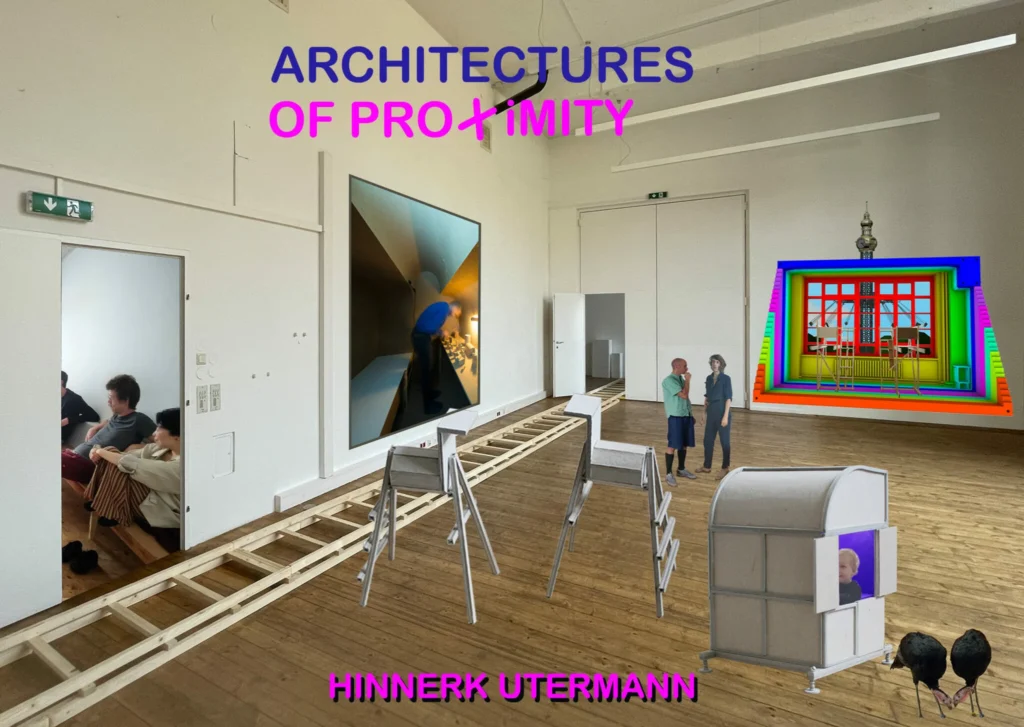
Architectures of Proximity ist eine künstlerische Forschung (PhD in Art) von Hinnerk Utermann. Das Projekt wird als gastgebende Praxis, als Ausstellung und performative Installation präsentiert. Die Thesis wird in einem Vortrag mit anschließender Diskussion vor der Prüfungskommission verteidigt.
Betreuer: Prof. Jan Svenungsson
Öffentliche Ausstellung
03.–05.03.2025
14:00–18:00
Zentrum Fokus Forschung
Rustenschacherallee 2-4
1020 Wien
Bitte kommen Sie näher! Trauen Sie sich. Nur 200 Schritte vom Prater entfernt, gibt’s Großes im Kleinen und Kleines im Großen: Eine Achterbahn aus Holz, eine bemannte Box, eine lila Wunderkammer. Pssst. Niemand kriegt’s mit, keiner wird erfahren, was hier drinnen vor sich geht. Aber eines ist sicher: Dank Ihnen verwandelt sich diese Bude in eine Versuchsanordnung.
Öffentliche Defensio
06.03.2025
10:00–12:30
Zentrum Fokus Forschung
Rustenschacherallee 2-4
1020 Wien
Kandidat: Hinnerk Utermann
Prüfungskommitee: Prof. Miya Yoshida, Prof. Jan Svenungsson, Associate Prof. Ingrid Halland, Prof. Mona Mahall, Heribert Wolfmayr
Architectures of Proximity untersucht das Phänomen der Nähe: Vier performative Installationen – Space Compartment One, Hochsitz, Talking House und Der Nächste – dienen als Versuchsanordnungen für Begegnungen zwischen jeweils zwei Personen, dem Architekten, Hinnerk Utermann und einem Gast. In einer Kombination aus autobiographischen Notizen und detaillierten Beschreibungen des Modellierungsprozesses erkundet die Arbeit die Beziehung zwischen gebauter Umwelt und menschlichen Beziehungen. Inspiriert von Edward T. Halls Proxemik, dem japanischen Teehaus und Absalons Cellules, entstehen Miniatur-Utopien, in der sich Fremde und Bekannte begegnen können.
Der*die Architekt*in tritt als Gastgeber*in auf und lädt dazu ein, über seine*ihre Rolle nachzudenken. Der Moment, die erlebte Umgebung wird über die abstrakte Planung gestellt. Nähe lässt sich kaum darstellen, sie entzieht sich der objektiven Messbarkeit. Die Dissertation verzichtet daher auf eine konventionelle Dokumentation – Begegnungen und Gespräche werden nicht aufgezeichnet. Stattdessen liegt der Fokus auf der Interaktion zwischen Materialien, Werkzeugen, Gästen und Gastgeber. Architectures of Proximity basiert auf einem Ansatz des ‚Bauens als Forschen‘, bei dem der handwerkliche Prozess des Modellbaus und das Modellieren selbst als verkörpertes Wissen im Vordergrund stehen.
Juli Sikorska: Collective Climate Imagination
Defensio von Juli Sikorska Doktoratsprogramm Künstlerische Forschung (PhD in Art)
19. – 23. January 2025
Zentrum Fokus Forschung
Rustenschacherallee 2-4,
1020 Vienna
Humanity is on the brink of a non-linear climate experimentation. Conventional solutions can’t solve our polycrisis; we need collective imagination to envision and create radically different ways forward.
This practice-based research investigates how collective imagination practices can catalyze climate action and adaptation in European cities. It explores transformative climate adaptation, the role of experiential interventions in surfacing emotions about climate futures and changing assumptions, and mindsets for organizing collective imagination work.
The research methodology combined participatory design approaches with auto-ethnographic reflection, culminating in the creation of an imagination collective. This collective developed and implemented multiple interventions, including two scenario narratives examining climate resilience and three place-based experiential interventions bringing together climate practitioners, and a framework for designing experiential climate scenarios.
Key findings demonstrate that the long-term, fundamental changes needed are not connected to current climate adaptation plans, and how embodied, emotions-based approaches such as immersive theater can help surface often-overlooked emotional and imaginative dimensions of climate action. The research shows how post-experience reflection can help shift perspectives about possible futures. It also suggests that organizing collective imagination work requires careful attention to power dynamics, trust-building, and balancing creation and resting.
This research contributes to both theory and practice by developing new metaphors for climate adaptation, creating a framework for designing for collective imagination, and establishing a living handbook for building imagination collectives. It argues that collective imagination practices constitute essential activities that catalyze social and ecological change.
The exhibition will include final artefacts from six projects and display work in progress.
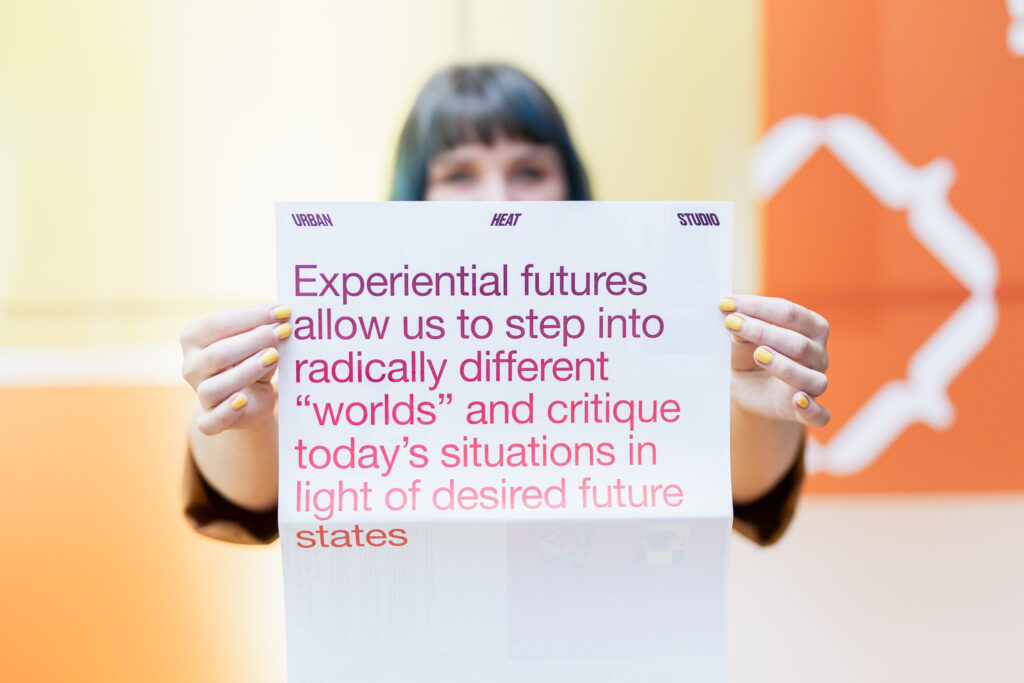
Juli Sikorska is a co-founder of Urban Heat Studio, a creative collective for transformative climate adaptation and imagination.
Exhibition
20-22 January 2025, 11:00 – 14:00
If you would like to visit the exhibition outside opening hours, please contact: juli@urbanheat.studio
Zentrum Fokus Forschung
Rustenschacherallee 2-4,
1020 Vienna
Defense
23 January 2025, 14:00
Zentrum Fokus Forschung,
Rustenschacherallee 2-4,
1020 Vienna
Supervisor: Anab Jain
Examination Committee:
Gerhild Steinbuch, Stuart Candy, Imandeep Kaur, Ruth Anderwald, Anab Jain
To participate remotely via Zoom, please contact: juli@urbanheat.studio
Call for Participation 2025:
Artistic Research PhD Programme (PhD in Art) University of Applied Arts Vienna
CALL FOR APPLICATIONS 2025
Artistic Research PhD Programme (PhD in Art) University of Applied Arts Vienna
Application period:
January 15 – 29, 2025, noon (CET)
Exclusively via the Angewandte Application Tool.
Start of studies:
October 2025
Q&A Session:
13 January 2025, 13:00 – 14:00 (CET)
Online on Zoom, registration via zff@uni-ak.ac.at
Application period: January 15 – 29, 2025
Exclusively via the Angewandte Application Tool (https://application.uni-ak.ac.at)
Start of studies: October 2025
The University of Applied Arts Vienna invites potential candidates to apply for the Artistic Research PhD Programme (PhD in Art). The Artistic Research PhD Programme is a postgraduate course of study in the field of art. The programme of study, conducted in English, concludes with the award of an internationally recognised PhD degree (see Curriculum).
The course of study is organised around topics and practices of artistic research, whereby the focus is on artistic work understood as the basis for knowledge production. Reflection on, and exploration of, specific methods and production processes in each candidate’s realisation of their artistic project is integral to the development and a critical component of the artistic research work. The final thesis consists of artistic work and a reflective documentation of the knowledge gained from the project. Artistic research, understood in the sense of comprehensive knowledge production, is defined as an open-ended process. The supervisors are professors at the Angewandte and are recommended by the commission responsible for selecting the candidates.
Among the selection criteria (see admission procedure) are up-to-dateness, innovative potential and prospective social relevance of the planned artistic research proposal, and the demonstration of knowledge of the national and international artistic and research context. Proof of general eligibility for postgraduate university admission (e.g. evidence of a completed, subject-relevant diploma or master programme at a university or college of higher education) and the favourable completion of the admission procedure is necessary. In addition to providing proof of qualification in terms of artistic development – documented by submitting a CV and a portfolio of artistic work – candidates must also submit a written exposé.
The documents for the admission procedure are:
- Professional artistic and academic CV.
- Exposé outlining the planned activity within the field of artistic research (max. 1,200 words, incl.footnotes, excl. abstract and bibliography).
The exposé should include the explicit research question or hypothesis; discuss the research context, methodology, project goal, and ideas for reflexive documentation while also providing a time plan for the project’s realisation. Please, include a paragraph indicating the field of your artistic research in relation to a potential supervisor1 at the University of Applied Arts Vienna (any person holding an artistic venia docendi).
(1 It is up to the commission to evaluate this part and to check the adequacy and availability of the potential colleague. You neither need to, nor should you, provide evidence of such colleagues’ availability, letters of their support, or reviews of your work prior to your submission.) - Portfolio
The proposal should be preceded by an abstract (max. 300 words), including the explicit research question.
All documents should be in English and compiled into a single PDF file in the following order: CV, exposé, portfolioThe PDF may be no larger than 50 MB. The PDF may contain links for downloading relevant material in widely used digital formats. Please, be aware that applications that exceed or do not fulfil the requirements will not be considered.
The application has to be uploaded online via the Angewandte application tool: https://application.uni-ak.ac.at The application tool is open from January 15 – 29, 2025. Applicants have to create and confirm a profile and upload the application document.
According to the admission process protocol, valid applications are evaluated by an examination board consisting of teaching staff members appointed by the University of Applied Arts’ rectorate. The committee is to determine whether applicants fulfil the requirements, select the most suitable candidates, and recommend supervisors for the individual projects.
The results of the admission procedure will be communicated to applicants by August 2025 at the latest. Admission to the programme does not imply the financing of the study.